

If your child was recently diagnosed with autism, or if you’re starting a career in behavioral health, you’ve probably heard the term ABA more than once. But what does it actually mean and why does it matter so much?
By the end of this post, you’ll understand what ABA is and why it is science-based, how it is used to promote quality of life, and the impact it has on personalized interventions.
Applied Behavior Analysis is a science. Not a therapy in the traditional sense, not a single technique, and not a fixed protocol. It is a scientific framework for understanding how behavior works, how it’s shaped by the environment, and how that knowledge can be used to help people build meaningful skills and live better lives.
A few principles sit at the core of everything ABA does:
- Behaviorism: The philosophical foundation of ABA. Behavior is shaped by the environment and by changing the environment deliberately, we can promote real, lasting improvements.
- Positive reinforcement: The primary mechanism for increasing desired behaviors. When a behavior is followed by something meaningful to the learner, it becomes more likely to happen again.
- Data collection and analysis: ABA doesn’t rely on intuition. Every intervention is monitored through data, which is used to evaluate progress, adjust the approach, and confirm that change is actually happening.
- Evidence-based practices: The strategies used in ABA are scientifically validated. That’s not a marketing claim, it’s a methodological commitment that distinguishes ABA from approaches built on tradition or opinion.
ABA is not just a tool for understanding behavior. It is an approach that transforms lives by teaching new skills, reducing challenging behaviors, and promoting independence.
Where ABA comes from
ABA is rooted in Behavior Analysis, a field grounded in the philosophy of Behaviorism developed by B.F. Skinner in the mid-twentieth century. The central premise is straightforward: behavior is not random. It is learned, shaped, and maintained by its relationship with the environment, what happens before it and what happens after it.
From that foundation, researchers began asking a practical question: if we understand what drives behavior, can we use that understanding to improve people’s lives in real, measurable ways? The answer was yes. And Applied Behavior Analysis was born from that question.
What makes ABA different
ABA is not a set of techniques you apply to a problem. It is a way of thinking about behavior, systematically, scientifically, and always in relation to the individual person in front of you.
What distinguishes ABA from other approaches is a commitment to a specific set of standards that define what good practice actually looks like. These standards, known as the seven dimensions of ABA, first described by Baer, Wolf, and Risley in 1968, are worth understanding, whether you’re a parent evaluating a program for your child or a practitioner building one.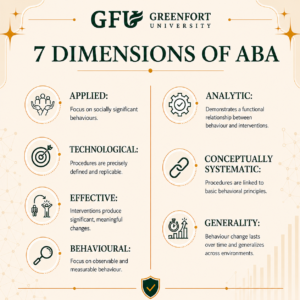
Applied means the goals chosen matter to the person’s real life. A socially significant goal isn’t abstract, it’s something that improves how someone functions at home, at school, with friends, or in the community. Teaching a child to cope with losing a game, for example, isn’t a trivial objective. It opens social doors that would otherwise stay closed.
Behavioral means the focus is on observable, measurable actions, behaviors that a third party can see and quantify. This is not a limitation; it’s what makes honest evaluation possible. If you can’t measure it, you can’t know if it’s improving.
Analytic means every intervention is grounded in evidence. The behavior analyst is not making intuitive guesses. Decisions are data-driven based on what the research says works, and on what the data from this specific learner is showing right now.
Technological means procedures are written clearly enough that any trained practitioner can carry them out consistently. If an intervention only works when one specific person delivers it, it isn’t truly technological. Consistency protects the learner.
Conceptually systematic means the techniques used are not pulled from different theoretical frameworks at random. They are derived from the principles of behavior analysis, reinforcement, extinction, discrimination, generalization, applied in a coherent, integrated way.
Effective means the intervention actually produces meaningful change. Not marginal improvement on a graph, but real, functional improvement in the learner’s daily life. If a program is not working, the program is the problem, not the person. A behavior analyst who finds an intervention ineffective adjusts the approach, not the expectations.
Generality means the changes that happen in a clinic need to also happen at home, at school, and in every environment where they matter. Skills that only work under controlled conditions are incomplete. The goal is behavior that lasts, travels, and expands.
Where is ABA applied?
ABA is widely recognized as the most effective approach for working with individuals with ASD and other challenges related to behavior and learning. But its reach extends well beyond any single population:
- Autism (ASD): Improving social skills, communication, and independence.
- Intellectual disabilities: Developing essential competencies for daily life.
- Education: Facilitating personalized teaching and learning processes.
- Healthcare: Applied in rehabilitation and habit-change strategies.
These applications show how ABA goes beyond generalized techniques, offering interventions that respect the unique characteristics of each individual. Applied Behavior Analysis is more than a scientific approach, it is a way of improving lives through personalized, evidence-based interventions.
What ABA is not
It’s worth being clear about what ABA isn’t, especially given the history of how behavioral interventions have been used and misused.
ABA is not a rigid, one-size-fits-all protocol. A well-designed ABA program is deeply individualized. It starts from what this person needs, what they value, and what will genuinely improve their quality of life.
ABA is also not a field that stands still. The neurodiversity movement and autistic self-advocates have raised important questions about how behavioral interventions are practiced, and the field has responded, with greater emphasis on assent, client autonomy, trauma-informed care, and person-centered approaches. These conversations are ongoing, and they matter.
Why it matters
When ABA is done well, when it is applied, behavioral, analytic, technological, conceptually systematic, effective, and built for generality, it is one of the most powerful frameworks available for helping people learn, grow, and gain independence.
It is a science. But more than that, it is a science in the service of people.