
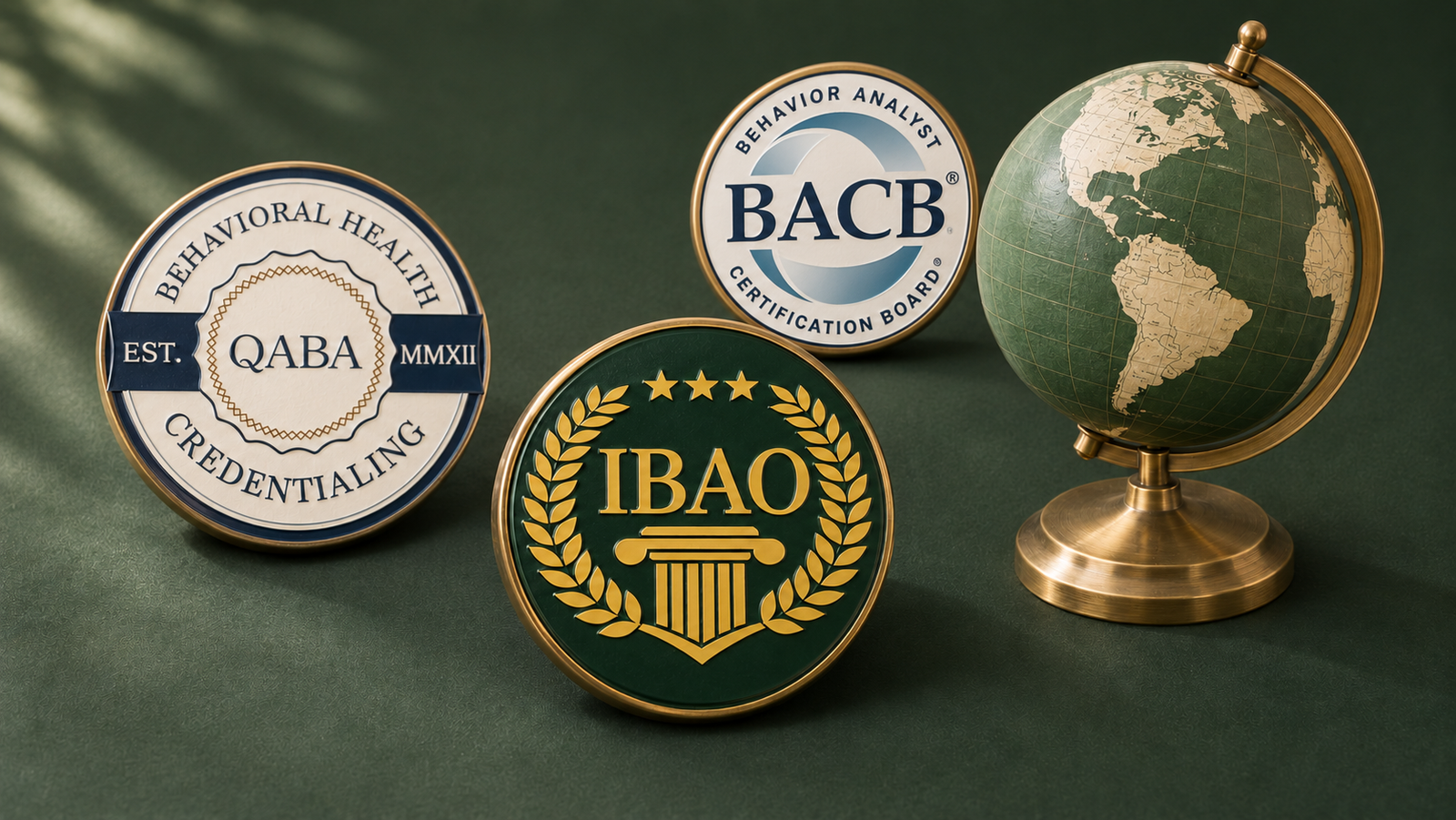
QABA, IBAO, and BACB are separate organizations that issue professional credentials in applied behavior analysis (ABA). Their main differences are the credentials they offer, eligibility requirements, supervised experience standards, and geographic access. Choosing a pathway means matching those requirements to your education, intended role, and where you plan to work.
If you are comparing QABA vs. IBAO vs. BACB, start by separating the organization from its credentials. QBA, IBA, and BCBA are analyst credentials issued by different bodies. None is a university degree, and they are not automatically interchangeable.
Information checked: . Requirements and geographic eligibility can change.
QABA vs. IBAO vs. BACB at a glance
This comparison identifies the main pathways. Credentials in the same row do not necessarily have identical scopes, requirements, or recognition.
| What to compare | QABA | IBAO | BACB |
|---|---|---|---|
| Analyst credential | Qualified Behavior Analyst (QBA) | International Behavior Analyst (IBA) | Board Certified Behavior Analyst (BCBA) |
| Other principal credentials | QASP-S and ABAT | IBT | BCaBA and RBT |
| Education for the analyst pathway | Qualifying master’s degree and required coursework | Master’s/Graduate Route or Experience Route | Qualifying graduate degree and pathway-specific requirements |
| Geographic access | International pathways | International pathways | Applications limited by residence; details below |
What is QABA?
The Qualified Applied Behavior Analysis Credentialing Board (QABA) offers credentials for different responsibilities in behavior analysis:
- ABAT — Applied Behavior Analysis Technician: an entry-level credential for implementing services under supervision.
- QASP-S — Qualified Autism Services Practitioner–Supervisor: a bachelor’s-level, mid-tier credential with defined service and supervisory responsibilities.
- QBA — Qualified Behavior Analyst: a master’s-level credential involving assessment, intervention planning, evaluation, and supervision.
The current QBA requirements include a qualifying master’s degree, 270 hours of approved coursework, 2,000 hours of supervised fieldwork, and an examination, alongside other eligibility conditions. Transitional fieldwork rules apply to eligible candidates who began before January 1, 2026.
QABA is the credentialing organization; QBA is one of its credentials. Completing coursework is one part of the certification process.
What is IBAO?
The International Behavior Analysis Organization (IBAO) offers two principal credentials:
- IBA — International Behavior Analyst: an analyst credential for professionals responsible for behavior-analytic services.
- IBT — International Behavior Therapist: a credential for implementing services under qualified supervision.
The IBA Handbook describes a Master’s/Graduate Route and an Experience Route, each with its own educational conditions. Both involve 270 hours covering Required Educational Objectives and 1,500 hours of supervised practice, including 75 hours of supervision. Additional requirements include skills assessments, continuing education, and the examination.
The Experience Route does not eliminate educational or competency requirements. Candidates should match their existing qualifications to the specific route before planning training and supervision.
What is BACB?
The Behavior Analyst Certification Board (BACB) offers credentials across three principal practice levels:
- RBT — Registered Behavior Technician: a paraprofessional credential for service delivery under close supervision.
- BCaBA — Board Certified Assistant Behavior Analyst: an undergraduate-level credential requiring supervision by a BCBA.
- BCBA — Board Certified Behavior Analyst: a graduate-level credential for behavior analysts.
BCBA-D is a doctoral designation available to qualifying BCBAs. It is not a separate certification and does not expand the credential’s practice privileges.
Under the 2026 BCBA Pathways 1 and 2, candidates complete a qualifying graduate degree, the applicable educational requirements, supervised fieldwork, and an examination. The BCBA Handbook specifies 2,000 hours of Supervised Fieldwork or 1,500 hours of Concentrated Supervised Fieldwork. The concentrated option requires a higher level of supervision.
Applicants planning for 2027 or later should use the BACB’s published upcoming requirements for their application date.
Which pathways are available to international applicants?
QABA and IBAO offer international pathways, subject to their credential-specific requirements. BACB applications are restricted by residence.
As of November 10, 2026, BACB accepts new certification applications from residents of the United States, Canada outside Ontario, and Australia. Important transitions include:
- United Kingdom: new applications ended on January 1, 2026.
- Ontario: new RBT and BCaBA applications ended on July 1, 2024; new BCBA applications ended on July 1, 2026.
- Australia: new applications end on January 1, 2027.
These dates concern new applications. Existing certificants may have continuing recertification options under the relevant policy. See the BACB’s international eligibility guidance and its Ontario transition notice.
Earning a degree from a U.S. university does not override BACB residency restrictions. An online program’s location and a student’s certification eligibility are separate questions.
How do certification, a degree, accreditation, and licensure differ?
These terms describe different kinds of qualifications and approval:
- Academic degree: a qualification awarded by a university after completion of a degree program.
- Professional certification: a credential awarded to an individual who satisfies a certifying organization’s requirements.
- Coursework or content approval: recognition that specified educational content meets a credentialing body’s standards. It does not automatically certify students.
- Educational accreditation: a review of an institution or academic program against an accreditor’s standards.
- Professional licensure: authorization from the relevant regulator where a profession is regulated.
The U.S. Department of Education explains institutional and programmatic accreditation as forms of educational quality review. A credentialing organization’s provider listing should not be presented as equivalent to institutional accreditation.
Likewise, holding a professional certificate does not automatically establish permission to practice in every jurisdiction. For U.S. practice, the Department of Education identifies state-level licensing authorities as responsible for recognizing qualifications for professional licensure.
How should you choose an ABA certification pathway?
The most useful starting point is your intended work setting. Consider these questions before committing to a program:
- Where do you plan to work? Identify the credentials accepted by relevant regulators, employers, and funding systems in that location.
- What responsibilities do you want? Direct implementation, supervised practice, and analyst-level assessment and planning require different preparation.
- What education do you already have? Compare your degree and coursework with the exact credential’s requirements.
- How will you complete supervision? Establish supervisor eligibility, qualifying activities, documentation, and costs before counting hours.
- When will you apply? Plan around the requirements that will apply at that time, including announced transitions.
For example, a student living outside BACB-authorized jurisdictions needs to resolve geographic eligibility before treating BCBA certification as an available outcome. A professional targeting a particular employer should establish which credential that employer accepts before choosing a pathway.
To connect these decisions with career possibilities, explore where an ABA professional can work.
Frequently asked questions
Is QABA the same as QBA?
No. QABA is the credentialing organization. QBA, or Qualified Behavior Analyst, is one of the professional credentials it awards.
Are QBA, IBA, and BCBA interchangeable?
No. They are issued by different organizations with separate requirements and scopes. Holding one does not automatically confer another or guarantee the same recognition by employers and regulators.
Do all IBA applicants need a master’s degree?
No. IBAO describes a Master’s/Graduate Route and an Experience Route. Each has defined educational and competency requirements; the Experience Route is not an exemption from professional preparation.
Can a U.S. online degree make me eligible for BCBA certification abroad?
A U.S. online degree does not override BACB residency restrictions. Eligibility also depends on the applicable education, fieldwork, examination, and other certification requirements.
Does completing a GFU program automatically grant certification?
No. GFU provides education. Professional certification is awarded separately by the relevant credentialing organization after the candidate meets its complete requirements.
How does Greenfort University support ABA education?
Greenfort University’s Master of Science in Applied Behavior Analysis is a 40-credit, 100% online program available in English, Spanish, and Portuguese. Its curriculum combines behavioral science foundations, research methods, ethics, assessment, and applied learning.
Students can verify GFU’s provider listings directly with the credentialing organizations:
- QABA: the Greenfort University directory entry identifies GFU as a coursework provider for ABAT, QASP-S, and QBA.
- IBAO: GFU appears in the Approved Content Providers directory under IBA Providers.
These listings concern coursework and educational content. They do not automatically award a professional credential or establish BACB eligibility. Each candidate must meet the relevant organization’s complete requirements.
Explore the M.S. in ABA, review admission requirements, or compare GFU’s ABA preparatory programs with your intended certification pathway.